01 July 2008

Review: Rob Neyer’s Big Book of Baseball Legends


by Rob Neyer


“Because only a good story well told is worth all this effort.”
- Rob Neyer in “Big Book of Baseball Legends”

The latest release from Rob Neyer, Rob Neyer’s Big Book of Baseball Legends: The Truth, the Lies, and Everything Else, follows in several of his traditions, but also explores some new ground. This is the third “Rob Neyer’s Big Book of…Something” though alas, he opted not to go with my suggestion of “Bubblegum” for the subject of his next work. Perhaps that’s still to come.

More important, Rob keeps with his traditions of seemingly endless and in-depth research, sharp, focused writing and an interesting subject matter.

As its title suggests, this book explores some of the legends of baseball history that we may have heard through the years. Babe Ruth’s famous “Called Shot” in the 1932 World Series against the Cubs is perhaps the biggest of them, but many and varied are the legends in this book, and they range from the commonplace to the obscure.

Most of us know about the rivalry between Carlton Fisk and Thurman Munson, about Billy Martin and Reggie Jackson. Maybe you know about how George Steinbrenner foolishly releasing Johnny Callison on a whim, or about Steve Dalkowski scaring the hell out of the Splendid Splinter. Maybe you’ve even heard about how Paul Waner was actually a better hitter when he was a little drunk, or of the impostor who kept Lou Gehrig’s consecutive games streak alive when he was laid up.

But what do you really know? The very nature of “legends” is such that there’s almost always a grain or two of truth wrapped up in a fanciful, entertaining, but largely untrue tale. Rob Neyer (and a guest or two) help to investigate, and in many cases, de-bunk, some of the more famous legends and tall tales from the history of baseball.

Rob doesn't get into exploring the allegations of baseball betting by folks like Pete Rose or Hal Chase, sticking instead to the fun stuff, like who hit a game winning homer off of whom on which date, or whether or not an event had the life-changing impact that was claimed by certain players. And these, it turns out, are the best sorts of legends to investigate, because the eventual outcome of any investigation is mostly of academic and human interest, having no impact on either the law or the record books. Well, mostly.

As is always the case with Neyer’s books, this one is eminently readable. Neyer’s prose is always solid, personable and fluid, with well chosen but not overly elegant words, and he makes no effort to impress you with his vocabulary. Some of the best writing in the book actually isn’t Neyer’s, but rather that of Scribbly Tate, who does the remarkably interesting chapter on the so-called impostor who replaced the ailing Iron Man to keep his 2,130-game streak alive. To be fair, though, this is more a credit to Tate’s unique written voice than it is a knock on Neyer, who’s no slouch as a writer himself.

Neyer’s digressions are always interesting and well informed, and he rarely goes of on a Posnaskian tangent, though those can be fun, too. The chapters are brief, usually no more than three to six pages, so the book can be easily read in small chunks whenever you have a moment to spare.

The main strength of the book, painstaking research, is also its one weakness. Or, if not a weakness, perhaps just a downside. The whole point in each chapter is to get at the truth behind the stories told by players, journalists and other baseball people, and that takes time and effort. Some of it could be done with Baseball-reference.com or Retrosheet, while other information had to be sought from the Hall of Fame archives or other out-of-print books.

This is all fine, but in a few cases it seems that the research goes a little too deep, exploring things that are beyond the scope of a particular legend, just to make sure that no stone is left unturned. In a few cases, by the time we get to the bottom of the story, Neyer has nearly forgotten what he was looking up, and so we find him looking for a strikeout when the story referenced a pop-up, or getting the names mixed up a little. These are few and far between, but they’re there.

The other downside to the painstaking research is, well, I’ll just say it: Most of the legends are not true. Almost every referenced story in the book is wrong in one or more detail, and most of them have either gotten various incidents mixed up with each other or are almost complete fabrications. If you’re ultimately looking for the truth, this is not a problem for you, but those of you who really like a good story, and want to keep believing in it, will have some of the wind taken out of your sails. Of course, you get warned about that right in the introduction, so if you’re upset about it, you’ve nobody to blame but yourself.

In all, the book is really a tremendous amount of fun. Neyer has done all the dirty work for us, spending hours and hours poring over the internet, old books, and even (get this) something called "microfiche", which it turns out is how they used to store really old information before Al Gore invented the Internet. All the leg work is already done, so you can relax with the book and a beverage in the comforts of your own home instead of in front of a big, flat screen with crusty old knobs in some dusty old library. Not that there's anything wrong with libraries.

So the next time a friend tries to tell you about how Fred Lynn always hit better against the good teams, or how Billy Martin turned the 1965 Twins into a running machine, or how Lou Boudreau turned Ron Santo from a nondescript catcher into the greatest thirdbaseman of the 1960’s, you can tell them they’re all wet.

And better yet, if you hear or read a story that’s not in this book (and there’s no shortage of those) you have a framework for how to find out whether that one’s true or not, too. Finding out the truth of these matters, it turns out, is almost as interesting as the embellished story itself. Sometimes, even more so.


15 June 2008

Major League Baseball is something of an anomaly in American sports. It is by far the most pastoral of games. This has obvious roots in the summer time game being played in fields when the ground was not rock hard, but goes beyond that.

Sports like football and basketball, which are the only other two that actually matter here (hockey used to but the NHL shot itself in the foot again and again and again…), are by far more physical. If you ever jogged to meet a pass in football you would be met by a safety that will drive his shoulder through your chest cavity. Basketball, as much of a non-contact sport as it is supposed to be, takes incredible strength to block out the other team on rebounds and band with jumping bodies as they drive toward the lane. Yes, baseball players run toward grounders and after fly balls, but apart from an occasional collision with a wall, the sport is quite contact free and includes an awful lot of standing around.

There is nothing wrong with baseball. The sport is part of the national landscape. The stands are still filled with fanatics who might harm another human being for Yankees tickets, but the game itself is more complex of a fascination than any other game. The fields are all different shapes and sizes. We may not have the ruins of Greece, the overpowering palaces of Louis XIV, or even the historic Globe Theatre of London, but we have our ballparks.

The Red Sox play with the Green Monster in left field because the park was built in an extremely confined space. The ingenuity that went into designing one of the most recognizable parks in the league is amazing. The Green Monster sits 310 feet from home plate and center field extends to 420 feet because of the odd geometry of the park. Half the reason many go to the park at sometime in their lifetime is to go a classic American structure.

Wrigley Field is not as much an oddity as Fenway, but the field itself is noted for its ivy covered outfield wall and its basket making that deep shot just that much more likely to go out of the park. It also discourages outfielders from running and jumping into the brick wall. Cubs tickets are purchased as much for the game as for the experience. The field evokes an escape to years before when people think of things as being less complicated (even though in reality they were…got to love nostalgia), from the small seats to the trough in the men’s room.

The game of baseball offers Americans and fans all over the world a chance to relax with play that is much skill play as much as it is a display of athletic prowess. Baseball builds slowly through the hot summers giving fans a chance to relax and remain competitive at the same time. Things begin to heat up in the fall as the few teams that are worthy advance closer to the World Series. This also allows things to cool off at parks where teams are out of it, of course then they have football season to keep them preoccupied.

- Guest written by David

08 June 2008

The Greatest Game: The Yankees, the Red Sox and the Playoff of ’78 by Richard Bradley

“It felt not just like a singular moment, but a fragile one, a rare convergence of tradition and rivalry and timelessness that would not be easily, if ever, re-created.”
- Richard Bradley in The Greatest Game


You know the story: The Yankees storm back from 14.5 games down in July to overtake the Red Sox in September, only to end up tied at the end of the season, forcing a one-game playoff at Fenway Park. The unlikeliest of players hits a home run to put the Yankees on top to stay, and then they sweep through the ALCS and the World Series to become world champions for the second consecutive year.

This might have been the shortest book ever written. I mean, Peter Gammons and Murray Chass probably summed it all up in about 1000 words the next day, right? But don't bet against Bradley. Thirty years later, with most baseball fans (especially those of the Yanks and Sox) having heard the story hundreds of times, Richard Bradley managed to find more. A lot more. He has put together a book that tells you not just about the game, but about the histories of the teams, the circumstances and events leading up to the game itself and background on many of the personalities involved.

And what personalities they were. George Steinbrenner. Mike Torrez and Ron Guidry, Reggie Jackson and Carl Yastrzemski, Bill “Spaceman” Lee and Goose Gossage, Billy Martin and Don Zimmer, Thurman Munson and Carlton Fisk, George Scott, Mickey Rivers, and of course, Bucky (F-ing) Dent. There are fewer characters at a Loony Tunes convention, and Bradley does each of them justice, in their turns.

The book gives some background, but then goes into the game itself, following pitch-by-pitch, an inning at a time, discussing personalities and histories of each of the players as they come to bat. In the alternate chapters, he goes into more detail on some of the more prominent people involved in the game, so the reader can have a better sense of the meaning and experience of the game from various perspectives. It’s an approach that works very well, as you really do find yourself identifying with each of these people, in turn, but the story of the game itself retains its tension, even though you already know how it turns out before you ever pick up the book.

Bradley’s prose is excellent, as you should expect from someone who has written a bestselling biography of JFK, has written for some of the best known periodicals in the country, and is a former executive editor of George magazine. About Billy Martin, he says, “Martin carried that me-against-the-world attitude, a combustible mix of courage and insecurity, pride and fear, into his play on the baseball diamond.” About the Reggie Jackson chocolate bar fiasco, he writes, “…and Reggie! Bars were raining from the sky like some high-calorie biblical plague.” Describing the aging, out-of-shape Bob “Beetle” Bailey: “…Bailey’s stomach pressed enthusiastically against his uniform.” The writing is very good, tight but descriptive, expressive without being verbose, and a pleasure to read.

If there is a problem with the book, and really, there aren’t many, it’s that Bradley mixes up a few of the minor, baseball related details. He’s written often and well before, but never about baseball, and it shows, though just barely. He gets a statistic wrong here and there (baseball fans are notoriously sensitive to this sort of thing), mixes up right and left field at least once, and gets a few other details wrong.

He mentions that the regular season tie in 1978 was the first such occurrence since 1948, but that’s only true for the Junior Circuit. He did not realize that since the National League’s by-laws were different, the regular season ties that happened in 1962, 1959 and 1951 (ending in Bobby Thompson’s famous “Shot Heard ‘Round the World”) were resolved by 3-game series between the two tied teams, rather than the American League’s one-game playoff.

Still, such qualms are relatively minor for such an otherwise excellent book. Bradley’s composed a volume that should be of interest to not just fans of the Yankees or Red Sox, but of baseball and history in general. OK, so maybe just baseball.

28 April 2008

FOX broadcast the Saturday afternoon Yankees-Indians game, so I got to watch some Yankees baseball on my television instead of MLB.tv, which was nice. These kinds of games are of course blacked out from MLB.tv as well as the MLB Extra Innings package you can get on most satellite and some cable systems. fair enough. But on Thursday night, I was blacked out of both the Yankees-White Sox game and the Mets-Nationals game, neither of which was being broadcast natioanally.

Several emails to MLB.tv customer service have done nothing to explain to me

1) Why this happened, or

B) if I should expect it to happen again.

According to their website, MLB.tv only has me blacked out of Phillies games, since my hometown (Bethlehem, PA) falls in their broadcast area. I live over 100 miles from New York city, and while I get some of the NYC broadcast stations, we do not get the YES network out here, not Sports NY, which does most of the Mets games, so it's not like the Yankees or Mets think of eastern PA as their broadcast area.

When I emailed MLB.tv customer service, they sent me the obligatory confirmation email, followed up by another one in which they asked me to provide more information (like my IP address, zip code, and where I was trying to watch the game from) which they said had been "previously requested". When, or by whom it had been requested, they did not say, but the remark had a distinctly snotty tone to it, like one of those teenagers who works in the computer store at the mall and gives you attitude because you don't already know the difference between DDR RAM and SODIMM.

I don't think I was supposed to respond directly to the email, but they did not provide clear instructions as to how I should furnish this information to them, so in my view, that's a failing on the part of MLB.tv as well.

They also suggested that I should make sure my "wallet preferences" were up to date and accurate. For the uninitiated, this means that I should make sure the credit card they have on file for me is accurate, though this should not matter either. For one thing, I bought the MLB.tv package for the whole year, and for another, even if I was paying for it monthly, We're still in the first month of the season, so there's no reason that I should be out of date on that front either. And besides, it's not as though the whold MLB.tv module wasn't working. I could watch the Reds game or the Padres game or the Mariners game if I so desired. Just not the Mets or Yankees.

All I know, at this point, is that I'm not supposed to be blacked out of any of these games, which I already knew, and that if I have troubles in the future, I can contact them through their website, which as it turns out, is pretty useless.

MLB.tv's product itself is pretty darn good, but on the whole, its customer service interface leaves a lot to be desired. An MLB betting man should not wager on getting a helpful response.

22 April 2008

Hammerin' Hank, George Almighty and the Say Hey Kid, by John Rosengren

The word "skeptical" barely begins to describe my demeanor as I was asked to review John Rosengren's new book, Hammerin' Hank, George Almighty and the Say Hey Kid.


First of all, I'd never heard of its author, so how good could the book be, right? Well, I'd never heard of Michael Shapiro before I read his excellent book on the Brooklyn Dodgers a few years ago. Before I happened upon A Dirty Job in the Allentown airport last summer, I'd never heard of Christopher Moore either, and he's now my favorite author. So I didn't give that particular prejudice too much weight.


More important, the book's subtitle "The Year That Changed Baseball Forever" kind of put me on my guard. And not just because it referred to 1973, and therefore happened before I was born. I had to take the title with a grain of salt, mostly because I just read a book last year about a team that (allegedly) changed baseball, just two years before this book supposedly did the same thing, and that, frankly that was a crock. And a really boring book.


Rosengren's book is neither.


This well-written, insightful and intriguing tome relates how the events of the 1973 baseball season, and several events that unfolded around it, really did change the game, and perhaps the country, for all time. Think about it:

* You had Hank Aaron chasing babe Ruth, right down to the last day of the season, contending not only with his aging body and racist death threats, but also the ambivalence of the baseball establishment (read: Commissioner Bowie Kuhn) and the people of Atlanta, who mostly ignored him right to the end.

* Willie Mays, the once great Giants centerfielder, was linping along in his last year as a player with the Mets, who somehow managed to get to the World Series despite winning only 82 regular season games.

* Reggie Jackson was trying single-handedly to not just win the AL pennant again, but to become the superstar that we all now know him to be, and while he was at it, he was also trying to change the way players dealt with both management and the media. He succeeded at all three.

* Pete Rose (this was before he bet on baseball, we assume) collected his 2,000th career hit, won his third batting title and his only NL MVP award.

* Charlie Finley was an odd juxtaposition of both progressive and traditional baseball values. For example, he lobbied for the Designated Hitter rule, which was accepted, as a way to improve offense levels in the attandance-challenged American League. He also suggested orange baseballs for night games, though these were only used in exhibitions. At the same time, he was a world-class cheapskate, losing his players' loyalty (and ins ome cases their contracts) over comparitively trifling sums because he simply could not stand to give up a dollar if he didn't absolutely have to.

* George Steinbrenner bought the New York Yankees for a song from CBS, and despite promises to keep building ships for a living, it was not long before he started meddling...and winning.

At the same time, America was still trying to get out of the Vietnam War, and the Paris Peace Accords were signed, though it would not be the end. By the end of the year, both the President and the Vice President were forced from office over separate political scandals, though Nixon made significant inroads with both China and the Soviet Union, helped to start the DEA, the Alaska Pipeline, and signed the Endangered Species Act, before he was forced to leave.

The World Trade Center, the CN Tower in Toronto and the Sears Tower in Chicago, the Bosporous Bridge in Istanbul and the Sydney Opera House all opened. The SkyLab launches mark the next step in manned space flight and exploration. Thalidomide settlement. The Stockholm Syndrome. The American Indian Movement standoff at Wounded Knee. Roe v. Wade. The Yom Kippur War. The Arab Oil Embargo.

Tie a Yellow Ribbon was the biggest selling single of the year. Elvis: Aloha From Hawaii was seen by over one billion people, and they didn't even have YouTube. Dark Side of the Moon was released. The Miami Dolphins became the first (and still, only) team in NFL history to finish a season undefeated. Secretariat won the Triple Crown. O.J. rushed for over 2,000 yards. Bobby Riggs and his big mouth were beaten (easily) by Billie-Jean King. Down goes Frazier! Down goes Frazier! Down goes Frazier!

It was a tumultuous time, you have to admit. And I hadn't even been born yet!

To his credit, Rosengren doesn't try to cover all of that stuff in his book, but he does touch on some of the bigger issues (like Watergate) and how the baseball world could never be wholly insulated from the larger culture. Steinbrenner's illegal campaign contributions to Nixon in 1972 were given special attention in the book,as was the effect of the investigation, and his eventual conviction, on his business with the Yankees). Rosengren also discusses the ways in which Steinbrenner almost immediately renegs on his promise to practice "absentee ownership" and "stick to building ships", and apparently had no shame about the way he wanted to run things. When Mike Burke, the general Manager of the team under CBS's ownership, was forced out, George simply explained that, "[he] didn't agree with everything I wanted to do, so I fired him." (p. 82)

Speaking of contentious and controversial owners, the Oakland Athletics, despite their success in 1972, were a wild bunch, and hated their cheapskate owner. "They disregarded authority with exhuberant contempt." (p. 29) Moreover, they nearly mutinied during the World Series when Finley's meddling forced secondbaseman Mike Andrews to agree to a false medical report in order to get someone else on the roster. Finley eventually forced out his manager, Dick Williams, lost his best pitcher, Catfish Hunter, and the AL MVP Reggie Jackson, once free agency took hold.

Finley's brainchild, the DH, was proposed essentially as a gimmick to improve attendance, which, it was though, would increase with increased offense. The American League in 1972 had averaged just 3.47 runs per game, 13% lower than the Senior Circuit, and almost exactly as low as the anemic 1968 season. Run scoring (and attendance) increased dramatically in 1973, and everyone was so pleased after only the first season of what was supposed to have been a three-year experiment, they decided to make the DH permanent. Hard to blame them.

With that said, I do have to take issue with Rosengren's contention that, "The experiment had improved offense, no question." Offense improved, sure, but how much did the DH have to do with it? Plenty, but not everything. The AL scored 4.28 runs per team per game in 1972, a 25% increase from the previous year, but only about half of that was due to the DH. The rest of it was due to the fact that the League as a whole just hit much better, and much more in line with historical trends. Designated hitters scored 0.58 runs per game in 1973, compared to only 0.14 runs per game by pitchers and pinch hitters in 1972, but everyone else in the American League jumped from a paltry 3.17 R/G up to a much more palateable 3.56 R/G. In short, it looks in retrospect like 1972's pitcher's paradise was just a fluke, which would likely have reverted to the mean anyway, at least to some degree.

Anyway, I'm off-topic. Back to the book.

Rosengren manages to relate some of the social and historical implications of the DH, the ways it was perceived and who actually embraced the role and succeeded at it. Ron Blomberg may have gotten his name in the record books as the first player to serve in the role, But Orlando Cepeda was the one who made the DH look like a good idea. Cha Cha was basically washed up at 35, but got a second chance in Boston in 1973 due entirely to the DH rule, and probably owes his Hall of Fame induction to it. (Rosengren mentions that Cepeda won the inaugural Outstanding DH Award in '73, though he fails to include the fact that Frank Robinson had a much better season. Baby Bull only got the award because it was started by a newspaper in New Hampshire, which is obviously in Red Sox Nation.)


The book, in fact, is really quite good. The author seems to be one of those select few people who can look at an array of information from various and sundry sources and not only see the big picture, but relate it to others as well. It seems that a lot of things really did change in 1973, and Rosengren weaves all the intricate parts of that season together for you, presenting the tapestry and explaining how it all fits, and what it all means.


How he managed to do this is beyond me. His bibliography lists over 50 different books, plus numerous websites, periodicals, audio/video sources and more than a dozen personal interviews with players and other personalities who lived the events in the book. And talk about meticulous! After the brief first chapter, every chapter has at least 29 end notes, and most have at least 60! The man obviously paid enormous attention to detail, working his butt off to verify and cite his sources.

The result is an interesting, well-researched, well-written and comprehensive work that tells the tale of a season that really did change the world of baseball forever.


08 April 2008

Somewhere along the way I became obsessed with statistics and baseball. Ever since I was a little kid I would take the box scores for the previous days games and line by line go through each game. The sport, with its highly structured play, makes it the best candidate of all sports to be continually dissected by numbers.

Basketball players are remembered for their dunks and three pointers, football players are remembered for their amazing side stepping moves and grit, and baseball players are remembered for the number of home runs they hit and the number of players they struck out.

In a sport where getting 25 more hits over 162 games can improve your hitting from .250 to .300, making you an All Star and saving you from the minor leagues, statistics rule the sport. The entire genre of fantasy sports has become a multi-million if not billion dollar industry because of baseball.

Using the simplest of numbers a lay person can predict the second half of baseball after the All Star game. Seeing that the St. Louis Cardinals are with in 3.5 games of the Cubs may worry some, but seeing that the run differential is only +16 while the Cubs are at +102 tells fans that the Cubs are blowing a lot of teams out while the Cards are scraping by.

Looking to the American League, the same thought process can be used. In the East, Tampa Bay has shocked everyone and many would doubt their ability to maintain that lead over the Red Sox and even the Yankees, but with a run differential of +75 they are just as solid as the Red Sox who are +77. That divisional race will be interesting to watch.

Looking at the numbers is not going to stop fans from buying Yankees tickets, but will tell fans that the Rangers are not as good their record indicates. They are actually -26 which means they have weak pitching and will eventually fade away.

The numbers also give a good overview of the strength of a division. The numbers are not good in the National League West, where the Diamondbacks and the Dodgers are tied for first place with sub-.500 records. Both teams have run differentials just over even, justifying their records.

Baseball will continue to be a game of little details and little numbers, but the game itself remains popular with just about everyone. Of course the caveat is that all the numbers go out the windows once the World Series rolls around.

- Guest written by David

04 February 2008

Harvard Boys, by John Wolff and Rick Wolff

I wanted to like this book.

I was offered a chance to review Harvard Boys back in November, and I finished reading it weeks ago, but I'm just getting around to reviewing it now. That should tell you something.

John Wolff went to Harvard, like his father, and was drafted in the later rounds as a secondbaseman, like his father. So, like his father, he decided to write a book about his experiences in the minor leagues. (His father's book, What's a Nice Harvard Boy Like You Doing in the Bushes? had a much better title.) Like his father, he's going to have to make a living doing something other than playing baseball, because he hit .207 in the Frontier League in 2006, and did not do much when he got signed by the Mets for the 2007 season.

John does have some interesting experiences here and there, and meets a few interesting characters. He has some successes and failures in his rare opportunities at playing time. He has a lot of ups and downs: getting signed by the White Sox and reporting to Spring Training, then getting stuck in extended Spring Training for two more months, getting assigned to a Rookie League team in Virginia...and then getting released two weeks later. He then got signed by an independent team in Michigan, and was doing pretty well when his shoulder got injured. Trying to play through the injury trashed his stats and eventually ended his season, though he did get signed by the Mets (as noted in the epilogue.)

But none of that, or almost none of it, is anything we haven't heard or read before. Another review of this book (I won't embarass its author) suggested that Harvard Boys was interesting because there aren't many other books that give insight into the lives of professional baseball players, besides Ball Four, of course. But really there are lots of books that do exactly that, and most of them better than this one. Pat Jordan's A False Spring, and A Nice Tuesday, and Jim Brosnan's The Long Season and Pennant Race, are classics of the genre. Newer variations on the minor league, "prespective of a nobody" theme incude Brett Mandel's Minor Players, Major Dreams, Steve Fireovid's The 26th Man, and Neal Karlan's Slouching Toward Fargo. On the major league level, Sparky Lyle's The Bronx Zoo gave unprecedented (and much more irreverent and biting) access into the clubhouse, and there are autobiographical books by Goose Gossage, Bill Lee, Mickey Mantle, Robin Roberts, Carl Erskine, Jim Kaat, Bob Gibson, Don Zimmer, John Kruk, Dick Allen, and Jose Canseco, just to name a few. Harvard Boys has nothing that these books did not have, John Wolff's personal feelings notwithstanding.

I tried to like Harvard Boys. I really did. John Wolff and his dad went to Harvard, a college with an academics-first mentality, much like my own (though I make no pretense that Lehigh is anywhere near as good a school as Harvard), so I had a soft spot for them before I ever picked up the book. I read the whole thing, cover to cover, unlike many book reviewers. I kept thinking that I must be missing something, that it would get better, but it never did. I tried and tried, gave it my best shot and all that, but alas, Harvard Boys never rose much above "mediocre" on my Book-o-Meter.

It's written reasonably well. No problem there. John Wolff has a Harvard education, a degree in psychology (at least he does now, having returned to finish his degree after his first stint in pro ball). So he can write. His style is mostly proper, though informal, but it's not terribly clever or interesting. He doesn't have many creative turns of phrase or quirky expressions or other literary goodies that make a book enjoyable to read. The book was compiled as a series of journal entries that John sent to his father, Rick Wolff, via email during the 2006 season, and it reads exactly that way: like he was sending emails to his dad, with no need to impress anyone with his mastery of the English language, no efforts to wax eloquent in any way. In and of itself, this might not be a bad thing, except that his subject matter does not make up for it either.

John Wolff repeatedly tells us, on almost every page, it sometimes seems, than minor league baseball is boring. The long bus rides, the long practices, long rain delays, long games with obscure players, the long waiting between chances to play, long nights and days off in cities and towns of which you've probably never heard, where there isn't much to do...yep, sounds pretty boring. You've got us there, John...but do you have to keep telling us so? The minor leagues are bad enough without being constantly reminded of how bad they are, don't you think?

One of the major differences between John's book and the one his father, Rick wrote (with Phil Pepe's help) about his time in the Tigers' minor league system back in the 1970's is that John's book includes his father's reflections and insights as well. Most of John's journal entries are followed by a brief response from his dad Rick, and some of these are interesting stories about amusing or odd things that happened to him back then, but sadly, many of Rick's insights aren't all that insightful. Some selected observations from Rick Wolff:

"Playing baseball is all about...playing." (p. 68)

"Even minor leaguers have to pay rent and buy groceries." (p. 127)

"Travel in the minor leagues is not glamorous." (p.184)

"John's right." (p. 202)

"Bottom line? It's boring." (p. 242)

"Nobody cares that you tried hard. All that matters are the results." (p. 245)
Unfortunately, that last one is also true of this book. It was, to be sure, a very good idea for a book, but the execution left a lot to be desired. Generaly speaking, I'd rather not review a book than give it a bad one, but with this book, I felt that it would be a disservice to my readers (the six or eight of you who regularly tune in here), not to tell you of my disappointment with Harvard Boys.

19 September 2007

3 Yankees vs Blue Jays Main Box 327 Tickets Sat 9/22/07

I've got three tickets for sale for Saturday's Yankees/Blue Jays game at Yankee Stadium. It's "The Bronx is Burning" DVD Sampler Day, and the game starts at 1:05.

You can buy them on eBay here.

I have another commitment and need to get rid of them, but of course I don't want to take a loss. The $200 minimum bid covers my expenses only, though if I can make a profit, all the better.

Happy bidding!

02 July 2007

Book Review: The Stark Truth, by Jayson Stark

The Stark Truth: The Most Overrated and Underrated Players in Baseball History
by Jayson Stark
C. 2007, Triumph Books, Chicago, IL
206 p., $24.50 US/$32.50 Canadian

Jayson Stark has won me over.

Not that he's necessarily convinced me that he's right about some of the things he thinks, and not that I automatically believe that anything he says is gospel. But I've decided that I like him, faults and all, if only for the simple fact that he's willing to discuss and defend his position, even with the likes of, well, me. It's that trait that separates Stark from the myriad of journalists who pontificate from their positions of power, safely protected by their editors, publishers, and the fact that they don't have a publicly known email address, spewing whatever they like without thought of reaction, retribution or repurcussions. Stark's very willingness to discuss his views, to debate and disagree without taking (or giving) any of it personally, makes him a fun guy to read and respond to, whether you think he's full of crap or not.

It is in this spirit, the spirit of debate and discussion, that Jayson Stark has written his first book, The Stark Truth: The Most Overrated and Underrated Players in Baseball History. It's a fun little book, easily read in a few sittings over the course of a week or two, if you want, and provides an excellent source for stirring up (what else?) debate. It's not likely to become a classic, like Boys of Summer or Ball Four, but it is a landmark book in that nobody's really ever written something quite like it before. (Christopher "Mad Dog" Russo, of WFAN in NY, wrote a book entitled "The Mad Dog 100: The Hundred Greatest Sports Arguments of All-Time" a few years ago, which was similarly designed to spur debate, but it of course focused on all kinds of arguments in various sports.) Stark's work, focusing on overratedness and underratedness in baseball, makes it unique.

I do wish that he had chosen a title for the book that didn't have his own name in it. It comes off a little presumptuous, but it also starts a dangerous precedent. I mean, how many book titles can you come up with that have "Stark" in the title? Stark Raving Mad, Stark Contrasts, Battle Stark Gallactica...the list soon gets pretty thin. Still, it's tough to come up with something pithy and clever when the subject of the book does not lend itself to being explained in any sort of clever or pithy fashion.

The book seeks to explore and describe, position by position, the most overrated and underrated players of all time. He looks at right- and left-handed starting pitchers, relief pitchers (without regard to handedness), designated hitters, and then each position around the field. Each position is examined first for overratedness, then underratedness, with the #1 player of each type at each position getting three or four pages of type, whereas the #2 through #5 playersgetting only a half page to full page synopsis. The players' key stats are listed for reference, and much of Jayson's writing goes into some of the more in-depth analytical tools, like RSAA, WARP, offensive winning percentage, etc. to help make his points that the players in question are really more or less valuable than general public perception would suggest.

This is where Jayson does very well. He uses these stats, and even introduces of them to the unitiated, to show that he grasps the fact that the traditional stats, like batting average, RBIs, and stolen bases, don't always show a clear picture of a player's value and skill. He makes use of the new-fangled stats to support his points, but for seam-heads and sabermetrics buffs, well, you're going to be disappointed. He doesn't have the room (or at least doesn't take the time) to go into the kind of depth you'd probably like to have to describe, for example, why Babe Ruth was a better pitcher than you probably know, or how it is that Steve Garvey was not nearly as good a firstbaseman as you may have heard. Just a taste of the more sophisticated metrics is all you get, and then it's on to the next player on the list. For most readers, though, that's enough, so you won't really find it a problem. Any more than a sampling of those kinds of numbers can get tedious, especially when you're talking about a book of a few hundred pages rather than a blog post or a 2,000-word column on ESPN.com, so Jayson does well to limit that sort of thing.

In the same vein, one of my issues with his book is that he writes it more or less exactly the way he writes his columns. He uses a lot of truncated, terse sentences, with irreverent little comments and such thrown in liberally. That's just his style. Whatever. But after several dozen pages of that, it get's a little old. In a column or especially a blog post, that kind of stream-of-consciousness writing seems fitting, but in a book, I personally expect a bit more eloquence. Another writing strategy you see a little too much is the use of parenthetical comments (something a good writer should not have to do) and while an occasional set of parentheses can be helpful (for colorvor clarification) having six or seven of them in a paragraph can get a bit annoying (as you can imagine) or at least choppy. Jayson is a good enough writer to compose a tome without such faults, and I hope that his next work will use them more sparingly.

Another aspect of the book that seems somewhat excessive is his feeling that, with every new chapter on the most overrated such-and-such, he needs to reiterate that just because he thinks a player is overrated does not mean that he thinks he sucks, just that he thinks that people may think a little more of him than he deserves. This is a helpful and important distinction to make, but I'm not sure he needed to make it a dozen times or more. I guess he's just a little overly sensitive because of all the belligerent e-mail he gets from easily-offended people who feel the need to CAPITALIZE EVERYTHING and can't spell porperly properly. Hard to blame him.

With that said, I am going to argue a little bit about some of his choices, or at least about some of his arguments on their behalf.

In naming Edgar Martinez the most underrated Designated hitter of all time, Stark has this to say:

"...if Edgar Martinez wasn't the greatest hitter alive during those 13 seasons [1991 to 2003], he was certainly the most dependable great hitter alive."

Well, that isn't remotely true. Barry Bonds racked up almost twice as many homers (575 to 284) and 211 more Win Shares than Edgar in those 13 years. Edgar finished a distant 4th in Win Shares, with 364, well behind Bonds, Jeff Bagwell (415), and Frank Thomas (414), and not much better than Rafael Palmiero (361) and Gary Sheffield (344). While Jayson does acknowledge the fact that certain players did have a few more doubles or a slightly higher OBP than Edgar, he entirely omits the fact that Martinez averaged fewer than 22 homers a year in that span, or that his total of 284 was exactly as many as Robin Ventura, good for only 25th place on that list. Edgar had a lot of hits, and a lot of doubles, but at a time when records for homers were being set everywhere you looked, Martinez somehow misplaced his invitation to that party. In addition, Frank Thomas gets nary a mention in the chapter on the DH, even though he's likely to own many of the career records as a DH by the time he retires. And as far as dependability is concerned, well, Edgar missed an average of almost 28 games per year in that span. Even accounting for the 70+ games lost to the strike of 1994-95, that's still about 360 games not played by "...the most dependable great hitter alive".

Anyway, enough on Edgar. Back to Jayson's book.

If you're a Yankee fan, you may not be pleased with many of Stark's choices, even though he goes out of his way (again, on several occasions) to make it clear that he has nothing against the Yankees in particular. His #1 overrated DH, secondbaseman, shortstop, thirdbaseman and right fielder are all players who played some significant portion of their careers in Yankee pinstripes, and many of those are most likey thought of as overrated because they were Yankees. Even so, you could do a lot worse than to start a team with Steve Sax, Phil Rizutto, Graig Nettles, and Dave Winfield, though I can definitely see his point on Ron Blomberg. In addition, among the #2 through #5 most overrated players in their respective roles we also see David Wells, Tommy John, Dave Righetti, Reggie Jackson, Steve Balboni, Cecil Fielder, Bobby Richardson, Bucky Dent, Mickey Rivers, Darryl Strawberry and Bobby Abreu, Yankees all, at least for a while. However, in fairness to Stark, he also calls several Yankees underrated, including the #1 catcher (Yogi Berra) and #1 reliever (Goose Gossage), and gives a little love to the likes of Chili Davis, Oscar Gamble, Joe Gordon, Tim Raines, Bobby Bonds, and even goes so far as to call Derek Jeter the second most underrated shortstop in history!

Personally, I'm a huge Yankee fan, and I almost crapped my pants when I read that! Derek Jeter? Underrated? Saying that people don't realize how good Jeter really is like saying that most people don't realize how crazy Tom Cruise is, or how hot Jessica Simpson looks coming out of a nightclub. Is it even possible for us to hear any more than we already do about Derek Jeter? I can't imagine how. Maybe if they started getting him to sell watches and perfume and peanut butter and giving him a chance to host SNL once in a while...wait a minuite, too late. OK, so what if he practically had his own personal announcer during Yankee broadcasts on national TV, who would, no matter what he does in the field, fawn over his every move? Oh, wait, Tim McCarver. Never mind.

Well, in spite of my vehement disagreement about this particular issue, I can see Jayson's points for most of the other players he names, and won't quibble with them beyond what I've already said. Stark knows his baseball history, and many of his Lamentations of Underratedness stem from the fact that the general populace has largely forgottten most of the men who played before 1990. Guys like Stan Musial, Yogi Berra and Warren Spahn were extremely well regarded in their day, but because they played so long ago, when thigs like the All-Century Team or the DHL Home-Town Heroes voting come around, they're not given the acclaim they deserve, and Jayson is right to point that out. Granted, the fact that the voting for those things is done mostly, if not entirely, on the InterWebs means that the average age of the voters is about 14, so it's hard to take those kinds of votes too seriously. Nevertheless, the results of those votes are very public events, held during the All-Star Game or the World Series, so maybe it's MLB that needs to re-evaluate how they do these promotions, not so much the average baseball fan who needs to reevaluate his opinions on the great players of the 1950's and 1960's.

Regardless of that, Jayson's book is a worthwhile read. It's just barely over 200 pages, and broken down into lots of easily managed chapters and sub-chapters, so you can find your place without much trouble again if you have to put it down for something. Like to have a fistfight with the guy who's trying to tell you that Nolan Ryan was the Greatest Pitcher Ever when in reality you know, like Jayson, how overrated he was. If you can, just enjoy the book, and the conversations it will generate, and try not to get beat up.

18 June 2007

You can hit a baseball homerun or even better - you can hit the jackpot playing the best casino games online at online-casino.com. The premiere online casino offers roulette, blackjack, slots and many more and the chance to enter the major league of online gambling.

15 May 2007

Game Review: Grand Slam Trivia - Yankees & Red Sox Editions


Grand Slam Trivia: Yankees and Red Sox Editions
Snap TV Games, Inc.
$24.95/each ($19.99 from Amazon)

Snap TV Games would like you to know about their new Yankees and Red Sox Editions of their Grand Slam Trivia games, available on DVD. I was able to review one of each of these editions in my home, and thought my readers might be interested to know about them.

Packaging: Each game is a DVD that comes in a normal-sized DVD case, and that comes within a board-game sized box. It's a bit more packaging than you probably need, but since you're buying it through the mail, it's probably just as well, to make sure the disc doesn't get damaged in transit. The packaging itself does look very nice, though, with slick looking graphics and Yankees or Red Sox insignias emblazoned on the box, the DVD case and the disc itself. There's nothing else in the box at all. No board, no instructions, no small pieces to lose. Just air, which means there's no reason to keep the box and packaging other than the DVD case afterthe first time you open it. Make sure you remember to recycle, kiddies.

Game Setup: Nice and easy. (New Yawk Translation: Fugghedaboudit!) You put the disc in the DVD player, it boots up and you can start playing right away (the "Grand Slam Trivia" option). The game also has an option for practice (the "Batting Cage"), and of course for the Rules, but nowhere are there any printed instructions to read, which means that the other players don't have to sit through listening to you reading the tedious list of rules, and you don't have to get annoyed if they don't listen. This was a particular bonus for me, as I hate it when people don't pay attentio...HEY! WAKE UP!!

Game Play:Anyway, in the "Batting Cage" (practice questions) there are several lines of questions, ranging from the basics of baseball rules and equipment up to specific questions about current and former players, the teams' postseason histories, legendary players (Babe Ruth, Ted Williams, etc.), ballparks and other subjects. When you play the game, of course, you can't select the subject of the question, only the difficulty, but when you do the practice mode, you get 10 questions from each category, with generally increasing difficulty, so that's a good way to prepare for the game. For questions you easily already know, you can select the answer before the voice is finished asking it, which helps to speed the game up. But don't wait too long to answer. If you're having trouble and pondering (or more likely, if your team is debating the correct answer), you only get a few seconds after he finishes asking the question to answer before the game "buzzes" and you're out.

The Boston and New York versions each have a man's voice with a city-appropriate accent to tell you what to do (check the Snap TV Website to hear the obnoxious accents, if you like), ask the questions and recite the answers. It's a nice touch, even if they are each a bit over the top with the accents at times, but it's still better than some generic, nondescript, midwestern accent, anyway. I wonder if they'll come up with a Twins Trivia Game and have someone with a Minnesoooota eaccent, dontyaknow?

Play occurs as a three-inning contest in which two sides take turns trying to answer the trivia questions. Pretty standard, so far. You get up to four "hits" (correctly answered questions) per inning, but you only get one "out" (wrong answer) and your turn is over. It seems kind of backwards, that you can get four hits but only one out, but I think if you did it the other way around, giving three outs per inning and allowing the player to answer questions until they got one wrong, they could make it extremely boring for the othey player(s). As it is, a typical game might take 15-20 minutes or so, and you're usually not sitting there doing nothing for more than a couple of minutes, which is not so bad.

You can try for a single, double, triple or home run, with difficulty increasing as the number of total bases does. The "Single" questions are almost ridiculously easy, but since you only get up to four hits in an inning, taking singles questions only gets you only one run per inning, maximum. I found that for my level of knowledge, I could correctly answer the "Double" level questions about 80% of the time, but that "Triples" and "Home Runs" were quite difficult, even for the Yankee stuff, which I like to think I know pretty well.

If you end up tied at the end of three innings, you go to (surprise!) Extra Innings. In this mode, the computer selects the difficulty level of the question, and you have to get a question right in the same inning in which your opponent answers one wrong in order to win. This goes pretty fast, which is also a good thing. Getting an inning or two of free baseball for the ticket on chich you spend $30 or $40 or $50 or more is one thing. Sitting there waiting for a computer/DVD game to end can be positively boring, so the way they've set this up definitely helps.

The Good: The packaging is compact, and the game play is easily understandable. The game itself frequently incorporates video highlights of players and games, both in the questions and the answers, so if you like watching some of the highlights on ESPN Classic and haven't the atience to wait for them to do a special on Jim Rice or Ron Guidry, then you can get a little fix here. And if you're a know-it-all trivia buff like me, you can show off by telling your friends about the answer to the question before the game has a chance to do it. Then, while the game plays the video and the obnoxiously-accented narrator explains the answer to the question, which is of course different from what you just said, you can feel silly. Or at least I can.

The Bad: They tell you that there are over 500 questions in each game, and there are about 10 or 12 categories in the practice mode, with 10 questions per session, which means that there should be 4 or 5 different sessions for each category, on average. "Five hundred" is a lot when you're talking about home runs or sacks of money, but when it comes to trivia questions, it's really not so much. For comparison, some of the Trivial Pursuit DVD games have 400-500 questions on the DVD alone, plus another 1800-2000 or more on cards, and even those start to repeat after you've played the game 4 or 5 times.
The Ugly: It's a bit nit-picky, but the $24.95 price tag seems kinda steep for a single-disc game that has 80% fewer questions than its competitors from Trivial Pursuit, which have boards and pieces, play up to six players, and are generally just more fun and engaging. However, you can get it for about $20 from Amazon, and it's still better than sitting around on the porch challenging your friends to answer obscure questions about your favorite baseball team, if only marginally better.

27 April 2007

Oasis Media Blitz


Spreading the word about a new worship service at First Presbyterian Church in Bethlehem, PA, starting on Arril 28th at 6PM. That's me doing the Chris Farley thing in the beginning and showing off the cards and posters, and my wife next to me, saying that we'll hand these out to "anyone we see". For the record, she promptly chickened out when faced with actual "anyone"s, but did very well at convincing shop owners to put the posters up in their windows in downtown Bethlehem.

24 January 2007

Feeding the Monster: How Money, Smarts and Nerve Took a Team to the Top

Feeding the Monster: How Money, Smarts and Nerve Took a Team to the Top
by Seth Mnookin

Hardcover, $26.00 US ($36.00 Can.)
c. 2006, Simon & Schuster

"...by the middle of November, they had a $20 million per year left fielder who wanted out, an $11 million shortstop so offended by the team's offer for an extension that his agent had told the Red Sox to trade him, and in Pedro Martinez, a $17.5 million per year starting pitcher who was already warning the team that if they didn't sign him to an extension before the season began, he wouldn't even speak with them once it was over. In the midst of all this, the Red Sox decided to pursue one of the most outspoken pitchers in all of baseball."


Any baseball fan with a modicum of intelligence (and who hasn't been under a rock for the last three years) should be able to deduce that this quote refers to the Boston Red Sox, in the autumn of 2003. In the wake of yet another heartbreaking defeat at the hands of the Hated Yankees(TM), the Sawx threw caution to the wind, stockpiled the best talent available, and set out to win themselves the championship that had eluded the franchise for 86 long years.

It worked, of course.

Author Seth Mnookin, in his mnew (sorry, I couldn't help mnyself) book Feeding the Monster, chronicles not just how "Money, Smarts and Nerve Took a Team to the Top", as the subtitle indicates, but how ignorance, cowardice, mistrust, mismanagement and bad luck had kept that team down for decades at a time.

Money was rarely a problem for the Boston American League franchise. Smarts and nerve? ...not so much. But even with all the money the Yawkeys had, as Mnookin tells, ownership did not always understand how best to use it, and when they did, there always seemed to be something holding them back. Usually it was the Yankees, of course, but other times it was just a bad hop by a ground ball, or a somewhat less than enlightened manager, or a gaggle of divisive beat reporters, or players who seemed selfish, overpaid, or just strange. There seemed to be no end to the misfortune that this franchise could suffer, to the point that some people thought they were Cursed. Whether you believed that or not, it made for an intriguing story. However, the decision to sell the team in the early part of this century brought about the possibility that it was how business was done, not where, that would make the difference for the Red Sox. New owners could overcome the so-called Curse, if given a fresh chance at it.

As the book's dust jacket tells, Mnookin was granted "unprecedented access" to the Red Sox inner workings, their front office personnel, players, history and records, almost all normally out of reach to researchers and journalists working with any organization, so much more so the Red Sox. Of course, until recently, "unprecedented access" could have meant that a Sawx beat reporter actually got some answers about some a prospect from the team's Double-A manager, or a quote from one of the team's players about a tough loss or a bold trade. The team's need to perpetually "feed" the Boston media "monster" with new stories, juicy details and lurid gossip about whatever was (or was not) going on with the team at the time, as much as anything, probably led to the paranoia surrounding the pre-Henry/Lucchino front office, and the Boston media were ready for a change. The Dan Duquette-led former regime in Boston operated under such a cloud of suspicion and mistrust that its relationship with the media was akin to a hijacker conversing with the bomb squad's chief negotiator. The main difference was that instead of a bank or an airplane full of people left wondering their fate, it was all of Red Sox Nation that felt like the information they craved was being held hostage by Duquette and Company.

After years of treating information like it was gasoline in a Mad Max movie, Feeding the Monster represents a frank and refreshing departure from that mindset, one that allowed Mnookin to write a book chocked full of quotations from key poeple in the organization, and to provide details of the Red Sox history that have too often been overlooked or ignored entirely. He dispels some of the myths that surround the Red Sox, like the one about how then-owner Harry Frazee sold Babe Ruth to the Yankees in 1919 in order to finance a play called "No, No Nanette" for exaple. A play that did not run until 1925. The popular notion of owner Tom Yawkey turns out to be a little naive as well. According to the National Baseball Hall of Fame, "The popular owner was a generous man and a leader among big league owners." and his HOF plaque lists among his qualifications, "RATED ONE OF SPORT'S FINEST BENEFACTORS. " That may be true, but he was also a petty, brash, brooding alcoholic who owned the Red Sox more as a way of vicariously living out his own failed athletic dreams than as some kind of altruistic service to the people of New England.

Fortunately, like Mark McGwire (and unlike the Red Sox for much of the last century), Mnookin doen't want to talk about the past, or at least he doesn't want to dwell on it for very long. He provides these facts as a background for the reader, to understand from whence this franchise has come, so that the reader can appreciate how difficult it was to enact such changes as they did when Tom Werner and John Henry bought the team and hired Larry Lucchino and Theo Epstein to be the faces of the team's front office.

Exorcising the Curse of the Bambino did not happen overnight, of course. But careful planning, well-considered free agent acquisitions, and some clever trades brought together a team that could compete, year-in and year-out. The offensive juggernaut they assembled, based largely on a Bill James-led statistical paradigm that valued on-base percentage and power above all else, set several records between 2003 and 2005, including becoming the only team in baseball history to score at least 900 runs in three straight years. In 2004, as you know, the stars aligned perfectly, and all the statistical analysis and gutsy moves (like picking up Curt Schilling, and trading away Nomar) paid off, as they won a championship for the first time ince the end of World War I.

But success, while it does seem to breed good team chemistry within a season, also seems to breed in-fighting and primadonnas the year after. Egos enlarged, but the clubhouse didn't, and the team's management suddenly found itself with a bunch of players who though more of themselves than was appropriate, simply because they'd been present when the Curse was broken. On the field, the pitching fell apart, but the offense was still very good, and they managed to hold on to win the Wild Card again in 2005, this time getting swept by the eventual World Champion Chicago White Sox in the Division Series. Worse yet, the Dan Shaunnessy-led Boston rumor mill made Larry Lucchino and Theo Epstein wonder about each others' loyalties, and their strained relationship eventually led to the boy-wonder GM refusing to return to the team after the 2005 season. That decision essentially hamstrung the team for the 2006 season, during which the Sawx finished lower than second place in the AL East for the first time since 1997, though that all happened after Mnookin published his book.

Without a working crystal ball to predict that result, Mnookin's book ends on a high note, projecting and predicting good things for the Boston franchise in 2006 and beyond. While he may have missed the mark a little on his 2006 prediction, Mnookin's general principle is spot-on: The Red Sox are under new management, with a new management style and a new approach to running the franchise that should consistently yield positive results for the Red Sox and their fans. If they keep to this model, there's no reason it should take another 86 years for Red Sox Nation to celebrate another World Championship.

And you would be a fool to wait even 86 minutes to read Feeding the Monster. Mnookin's fluid writing style and remarkably interesting subject matter make it almost impossible to put this book down, and his insightful quotes will help to offer you new perspectives on people you thought you understood already. Even if you're a Yankee fan, like me, you'll appreciate reading the opposition's game plan, if only so you can be prepared to counter it.

24 August 2006

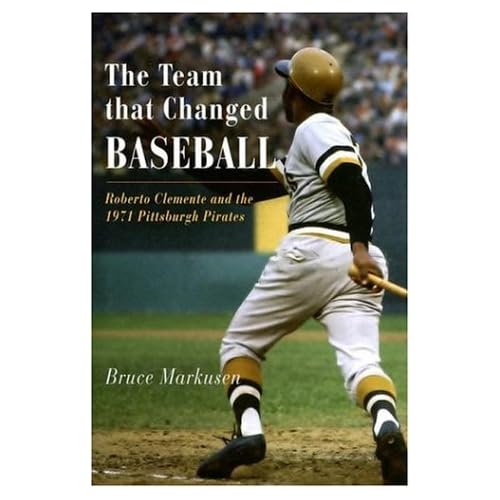
The Team That Changed Baseball: by Bruce Markusen

The Team That Changed Baseball: Roberto Clemente and the 1971 Pittsburgh Pirates
By Bruce Markusen

c. 2006 Westholme Publishing Inc. 240 pgs. $25.00 (paperback)

Fellow blogger Bruce Markusen's newest book covers the story of the 1971 Pirates team from beginning to end, and goes beyond that, really, since it starts with General Manager Joe Brown’s assembly of the club in the winter of 1970-71 and ends with a “where are they now” epilogue. Markusen’s fond memories and thorough research, buttressed by numerous personal interviews with some of the surviving personalities form that team and that time, provide for an extremely detailed description of the season, the players and the games. The reader is led through the year, month by month, game by game, and gets the kinds of details most people would only know from having been there, which is generally a good thing. But baseball isn’t called “The Long Season” for nothing, with a month of spring training, 162 regular season games and (mercifully, in 1971, only) two rounds of playoffs to cover, not to mention the important events of the preceding and following winters. Over such a long span, the particulars of individual games get a little tedious, especially if you aren’t as invested in the Pittsburgh franchise as Markusen evidently is.

The premise of the book is that the 1971 Pirates, being the first team in Major League Baseball to field an all-minority lineup, and actually winning as they did so, showed the rest of MLB and the world that success could be achieved regardless of the colors of players’ skin. GM Joe Brown’s acquisitions of players to bolster his roster based on his team’s needs, and the players' talents, rather than their status as black or white or Latino, served as a model for other franchises to consider abandoning any official or unofficial racial quotas they may have utilized. That manager Danny Murtaugh daily filled out his lineup card without regard to race or ethnicity is a credit to his open-mindedness and gave other managers an example to follow. But if the team had not succeeded, if they had not won the National League and eventually the World Series, perhaps fewer heads would have been turned and the impact that Markusen discusses might not have been realized in MLB for much longer.

Jackie Robinson debuted with the Brooklyn Dodgers on 15 April 1947. The fact that it took over 24 years, until 1 September 1971, for an all-minority lineup to take the field in a major league game is a testament to the resistance of the establishment, any establishment, to change. In spite of the major leagues being officially “integrated” as of 1947, it took years for many teams to employ their first black player, the last of them being the Boston Red Sox, in 1959. Some teams were slow to embrace the new policy, at least until they saw that black players could win, and the 1971 Pirates definitely put to rest any questions that might have remained about the quality of minority players.

Markusen is an avid baseball fan, one who's written several other books about baseball, who works at the National Baseball Hall of Fame and Museum in Cooperstown, and whose name, when Googled, provides a host of baseball blogs, online journals and other articles from his hand. The man could hardly have a more impressive set of credentials. The book itself is sufficiently well written, with game stories and quotes that any team's beat writer would be proud to call is own, but as a book, The Team That Changed Baseball comes off a little dry. Beat writing is fine for the daily papers, but a book, to keep a reader interested, needs a little more life and a little less detail, I think. Interjections of the author's humor, his opinions, and creative word-smithing can make a book more pleasant to read, but Markusen mostly fails to include such things in this book. Perhaps more discussion of how other teams, other players, and especially fans and writers saw this team, how they reacted to the '71 Pirates and their handling of racial issues, or social issues facing the country as a whole, would have helped make the book more of a page-turner. Even painting such things in broad strokes tends to create a more intriguing picture than the simple, plodding, game-by-game, inside-the-clubhouse vantage point he takes through most of the book.

I suppose that with a title like "The Team That Changed Baseball", Bruce was sort of setting the reader up for disappointment, like calling your sports team "The Unbeatables" or naming your first born son "Jesus". Other books that have followed a team for a season or longer, Roger Kahn's Boys of Summer or Seth Mnookin's Feeding the Monster (which I'll be reviewing soon), for example, manage to include more of the emotional aspects of pursuing baseball's ultimate prize than this book did. Markusen by no means ignores the racial, ethnic, social and emotional aspects of the story, but too much of his effort, in my opinion, is squandered on who hit a home run or pitched two and two thirds innings of effective relief during a particular game or series in April or July or September, things that amount to largely inconsequential details if you're trying to make an argument that this team "changed baseball".

The fact that this 1971 Pirates team, on paper, looks very much like any number of other good teams, testifies that the "change" took, that for the last 30-plus years just about every team has been built based on talent rather than race. Whether the '71 Pittsburghs were the first team to try this, or just the first team to succeed remains an open question, but in any case they were the first team to be recognized as having been assembled this way. That alone makes this an interesting team, especially if you happen to be a Pirates fan, not to mention all the personalities on the team: NL MVP Willie Stargell, manager Danny Murtaugh, Dock Ellis, Steve Blass, Mudcat Grant, Manny Sanguillen, and of course, Roberto Clemente. There's no shortage of stories and quotes from this group, ways that they struggled, and succeeded, in getting along and in winning.

For his part, Markusen does a great job of keeping the reader in suspense, despite the fact that the events he describes happened 35 years ago. You really do feel like you're not sure the team is going to win. They took over first place in the NL East in early June and never relinquished control, building up a 10+ game lead and never letting anyone within about 3.5 games of first place after that, but still, you worry as they suffer through a 14-17 August. You worry as they get swept in four games by their likely playoff foe, the San Francisco Giants. And even after dismantling the San Franciscos three games to one in the NLCS, you worry as they face the heavily-favored Baltimore Orioles, with four 20-game winners, in the World Series. Markusen's attention to game details serves us well in these situations, particularly the playoff games, as he keeps you on the edge of your seat for all seven games of that Series, right to the very end.

In total, I think I'd give this book a hesitant recommendation, say, one and a half balls, on a scale of four. If you're a Pirates fan, I'd make it two and a half balls, and if you're Steve Blass, needing a diversion from broadcasting this year's dreadful Pirates games, it gets four balls. Blass should be pretty familiar with what that means.

07 August 2006

Rob Neyer's Big Book of Baseball Blunders

Mr. Wrigley [...] announced [...] the College of Coaches. The idea was that eight top coaches would rotate through the organization, from Class D all the way up to the big club, ensuring that players at every level were taught the same way to botch rundowns, miss cutoff men, ground into double plays, and so forth. [But...]

Who would manage the Cubbies?


Rob Neyer's Big Book of Baseball Blunders

by Rob Neyer (duh)
c. 2006, Simon & Schuster, NY
Paperback, $16.00 US/$22.00 Canadian

The newest book from ESPN's Rob Neyer, the self-named Big Book of Baseball Blunders, follows on the heels of last year's Big Book of Baseball Lineups. I don't know if Neyer is planning a while series of such works, (Rob Neyer's Big Book of Baseball Managers, Rob Neyer's Big Book of Baseball Equipment, Rob Neyer's Big Book of Baseball Ballparks, Rob Neyer's Big Book of Baseball Bubblegum...maybe not.) but you can count me in on the rest of the collection.

In this book's introduction, Neyer makes a particular point of defining the difference between a blooper and a blunder. Bloopers, i.e. on-field, spur-of-the-moment mistakes, happen all the time, and while they make the game more interesting, there's not really any way to second-guess a blooper. They just happen, and if you could prevent them, you would do so. But blunders, pre-meditated, well-thought out decisions that somehow go horribly, horribly wrong, those make for some pretty good conversations, and a pretty interesting book.

Neyer runs (mostly) chronologically through baseball history, starting with some bad decisions made by the Sox (the White ones in 1917 and the Red ones shortly thereafter), and goes straight through to Joe Torre's failure to use Mariano Rivera in a tied, extra-inning game during the 2003 World Series. He examines some of the best-known, so-called "classic blunders" (the most famous of which, is "never get involved in a land war in Asia"), but only slightly less well known is this: Never sell your best player to your biggest competitor (like the Red Sox did with Babe Ruth in 1919)!

Most of the blunders fall into one of three categories:

1) Use and/or mis-use of certain players, especially during the playoffs.
These blunders include Walter Johnson being left in too long during the last game of the 1925 World Series, Leo Durocher's failure to calm down Hugh Casey after Mickey Owen dropped what would have been the last out of the 1941 World Series, Casey Stengel's failure to use Whitey Ford three times in the 1960 World Series, and the aforementioned 2003 World Series relief pitching blunder.

Some of these types of blunders are much-debated, well-known, long-term mistakes, like Don Zimmer's mis-use of his bench (and other assorted mistakes) during the Red Sox doomed 1978 pennant drive. The St. Louis Browns' playing of a one-armed outfielder, Pete Gray, in 1945 stands as one of the more interesting stories in the history of major league baseball, an encouragement to handicapped people everywhere, I suppose. But Neyer details how Gray's presence on the team may (or may not) have cost the team the pennant.

B) The sale or trade of a great player prematurely.
Babe Ruth to the Yankees. The Pirates trading away Kiki Cuyler and Joe Cronin. The Tigers trading away a young Carl Hubbell. The Red Sox selling Pee Wee Reese to the Dodgers. Roger Maris. Steve Carlton. Frank Robinson for Milt Pappas (for Christ's sake!) Larry Anderson for Jeff Bagwell. There are, in fact, two whole chapters on bad trades, interspersed throughout the other sections, most of which are entire chapters detailing only one such tremendously bad decision.

These particular types of decisions make for some of the most interesting discussions. Some of the most famous trades/sales of players, like Babe Ruth or Pee Wee Reese or Fred McGriff, are well known for how the seem to have afflicted their former organizations for such a long time, but one of Neyer's best attributes as a writer is his penchant for analyzing both sides of an issue. He looks intently at some of these transactions, and many of them, it turns out, were not such a detriment to the franchise as you might expect. In most cases, teams that jettissoned players were either so far out of contention that the player would not have made a difference, or they had an established player in the same position and couldn't have used him anyway. Of course, that wasn't always the case, but you'll have to read the book to find out which ones

iii) Ill-considered organizational choices.
The owners naming a former military bigwig to the position of Commissioner. Collusion. The owners refusing the Charlie Finley Option of annual free agency for every player. Collusion. Candlestick Park. The Cubs' College of Coaches. Collusion.

Man, the owners have made a lot of poor choices over the years, haven't they?

These blunders, without necessarily having the debate and the local flavor of some of the bad trades or poor managing decisions, often have much more far-reaching consequences. Old time Dodger fans probably still debate Walter Alston's many poor decisions during the last game of the 1962 World Series, but very few baseball fans of any team stand around discussing how the owners' short-sightedness cost them millions of dollars, both when they missed the boat on perennial free-agency, and when they boarded it on Collusion. All three times.

There are other types of blunders, of course. Amongst those he discusses, Neyer also includes interludes on various other types of mistakes. Bad drafts. Managers who should not have been managers. Numerous instances of teams missing the playoffs by the smallest of margins, where the decision to use or not use certain players made a real difference in the race.

Baseball's long, rich history offers many opportunities for second-guessing. Managers, owners, players: nobody is immune from criticism, and Neyer doesn't pull any punches in his critiques of people and organizations. As a writer, his skills cater well to most people, with a plain-spoken tone that makes you feel as if you're having a conversation about the book's subjects over coffee and a doughnut, rather than reading them in a book. His wry humor shines through in his writing as well, as do his intelligence and thorough research, his unique insights and his even-handedness when looking at both sides of the issues.

As a long-time reader and fan of Rob Neyer and his work, I never doubted that I would enjoy this book, and I was not disappointed. But I severely underestimated how much baseball history I would learn from it, and I was pleasantly surprised at how entertaining it would be, even in its discussions of business, politics, and attendance numbers.

Neyer's writing, and the brief nature of each discussion, most chapters lasting only three or four pages, makes this an eminently readable book. If you've only got ten or fifteen minutes, sit down and read a chapter, but you won't get bored if you prefer to read four or five in a sitting. Even shorter periods of time will still allow you to read one of his three or four paragraph sidebars in most chapters, some of which play "devil's advocate" to the chapter's main point, others of which simply outline some other blunder made by that person or organization around the same time. Coffee table, bookshelf or back of the toilet, Rob Neyer's Big Book of Baseball Blunders will be at home nearly anywhere you decide to put it.

The worst blunder you can make is not reading it.